
Last week, a petition emerged, organised and supported by a group of parents, aimed at challenging the new hierarchy of the school I work at. It has gained 228 signatures. The petition was provoked by a tightening of rules and raising of expectations around school; a more rigid enforcement of uniform through students receiving a negative point for infractions (which exempts them from weekly rewards), the removal of toilet and SEND passes which previously allowed students with specific needs to take themselves out of class, and an increase in sanctioning via detentions for lateness, truancy and defiance to staff.
This reflects a conflict of vision, between the school hierarchy and this group of parents, of how a school should be run. To understand how, and possibly why, these visions conflict, I have tried to outline the core values which lie at the root of them. I found they contain contrasting understandings of freedom, and that this could explain why both sides struggle to understand each other.
The vision of the parents: Values of individualism, mutual respect, and anti-authority. Children as individuals.
The petition begins as follows:
‘Deeply concerned parents are appalled, upset and frustrated by the current state of our how the **************** Schools in *********** are being run.
This petition using the Change platform is to give everyone parents, carers, neighbours, staff the whole town a chance to sign and express as collective how they feel’.
The petition, in sum, describes how the school has become…
‘Cruel, chaotic, neglectful and children are paid and bribed with dinner money or the chance of a hot chocolate if they behave. This has become a toxic militant environment and is no longer an educational institution where young minds are being nurtured’.
The petition contained a comment section where other parents expressed their views. These comments fundamentally oppose the rationale behind the tightening of rules. They derive from a vision of how people should be treated. They value the rights and dignity of the individual, and believe that these should be extended to children.
‘Our children are in their care and they are there to nurture and provide an education to our children. Not to treat them disrespectfully and at best like crap. They expect respect off of these children but respect has to be earned and in order to earn that you treat others how you expect to be treated. They show no respect to our children and certainly are not nurturing them and preparing them for life after school!’
‘The rules in this school have gone Prison like. I witnessed it first hand the other morning. Let our kids enjoy their school life. Enforce punishments appropriately not hand them out like sweets!’
‘This is not the army, treat pupils with respect to gain respect. Get on with the education.’
Broadly, their vision holds that students are individuals and are entitled to rights of individual freedom. Individual freedom is understood as an individual’s capacity to determine their own best interest and to take decisions which serve that end. Students should be entrusted to calculate their own best interests. They should be able to express this freely and teachers should endeavour to support accordingly.
They believe the school is enforcing ever-stricter rules so that it can control students. Control is the easy option, requiring less staff, effort and expertise, as opposed to understanding and catering to the individual needs of students. Efforts to reward ‘good’ behaviour with chocolate, money and early lunch are just ‘bribes’; ways of manipulating students towards conformity. These bribes distort the purity of the individual decision. They believe students should be treated by staff with respect and dignity. This is how recognition of the individual liberty of students manifests. It means staff take student concerns at face value, and students have the right to meaningfully determine how each interaction with teachers plays out based on their own calculation of the legitimacy of the authority of the teacher or the rule the teacher is enforcing. Respect is earned. A student can legitimately withhold respect for teachers, if they feel their individual liberty is not being respected; if they are not being listened to, or if they are asked to do something which jars with their own calculation of their best interest.
Behind this outlook lies a distrust of the school, and perhaps establishment institutions more broadly. This distrust is experienced prior to the outrage at the new set of rules. The parents distrust the school to deliver something of value to their children and their family. Rules are therefore perceived solely as attempts at control, as opposed to steps toward reward further down the line, since parents do not believe the rewards will come. In short, these parents do not believe in the supposed ‘end’, and so the means appear like an end in themselves. If they did, opposition along the lines of individual rights would not exist; parents would happily support a system which they trusted would provide their students excellent outcomes, whilst demanding they, say, have their shirt tucked in along the way.
The vision of the school: The values of deference to authority, self-discipline and collectivism. Students as children.
The vision of the school under the new leadership contrasts this. The vision holds that staff are in charge. Staff carefully organise a culture formed of rules, routines and expectations which ensure students can pursue ends which will have a lasting benefit in their life. The culture should provide students will a clear path to success. It should incentivise buy-in through both rewards and sanctions.
The rationale is, if not provided clear rules around how and when they learn, some students will take decisions which are not in the best interests of their education. Similarly, if not provided clear rules around how they behave, some will take decisions which will cause harm. As a teacher at the Michaela Community School (academically, the best performing school in the country) stated in a recent documentary (Britain’s strictest headteacher, ITV), ‘if an adult is not in charge of a space, someone else will be, and the chances are, that person will be a bully’. Staff are best equipped with the expertise, perspective and temperament to arbitrate spaces fairly, and determine the best interests of the students. They should be empowered to do so.
To the school hierarchy, arbitrary rules around uniform, equipment and language provide two benefits, when enforced consistently. Firstly, they provide students with easy ways of succeeding, and increases the number of opportunities staff have to offer students praise. Secondly, they ensure compliance at a more granular level, so that large-scale infractions, such as those which disrupt learning or harm other students, do not occur. The idea is by demonstrating that praise and rewards follow from adherence to rules, students by-in to the authority of the staff, making them more receptive to guidance around more significant skills and knowledge. The process is often described as creating a strong ‘school culture’.
This vision differs sharply from that of the protesting group of parents (whose vision of moral practise in education demands a high threshold of individual freedom) in that it understands students as children, requiring clear direction from adults to grow. The parents believe freedom is when the individual determines what is best for them, the school believes that freedom is when students are directed to make the best choices for their future by more knowledgeable and responsible adults.
This school’s vision is also borne of the failures of the old system; when students had relatively significant autonomy to determine their lives at school. Passes were issued to several of our most vulnerable students which, for various reasons, enabled students to take a break from lessons. Medical exit passes, SEND passes, and inclusion passes all allowed students to exit lessons when they deemed it necessary and walk the corridors without an adult. These passes were used responsibly in some cases, but were also widely abused. Anecdotally, in the two years that these passes were in effect, the students who possessed them in my classes learnt little-to-nothing, since they were frequently deployed as we approached the most cognitively challenging part of the lesson.
Contrasting visions.
Lea Ypi’s book Free is, among other things, about the word ‘freedom’ and the many ways it can be understood, used and misused when understanding politics. It is a personal account of her own life growing up in Albania first under socialism and second during the fall of the socialist state and the rapid attempt at economic and political liberalisation. Fully educated in the socialist ideals of the Albanian state, in the opening scene of the book she describes her confusion as a young girl at hearing protesters on the streets shout ‘democracy! Freedom!’. She wonders:
‘perhaps both sides were simply chasing each other without knowing who was following whom, and that is why people had started to shout ‘Freedom, democracy’, out of fear, and uncertainty, to explain that this was what they did not want to lose, rather than what they wanted’.
For, as she understood it, ‘socialism gave us freedom. Nobody was looking for freedom’. Surely, she thought,socialism is democracy; it is the rule of the workers, everyone is equal and is given what they need to survive.
As well as the confusion around the use of the word freedom as opposed to socialism, Ypi also describes how the chants of the protestors contradicted her everyday experience of freedom; the way people were neighbourly, but selectively so, sharing and loaning resources only to certain families with whom they were friendly. The freedom with which these alliances were formed, through acts of generosity and favour in the queues for groceries, where people reserved spaces for friends who were unable to endure the long wait for the truck to arrive. Her freedom as a young girl when deciding whether to go home from school via her friends house, or to go via the women who would sell her sunflower seeds. The overarching point she makes convincingly is that political and economic circumstances frame and restrict ones life, within which individuals exercise a degree of freedom, and that this is as true of liberal democracy as it is of socialism. In both, the freedom individuals experience has to be carefully qualified and one cannot say it exists in one system but not the other. To illustrate this point she describes the collapse of the socialist state in April 1991 and the subsequent civil war in 1997, when Albania was treated with ‘shock therapy’ by teams of representatives from Western IGOs. This rapid liberalisation without secure and stable institution led to the rise in criminal gangs working in sex and drug trafficking, as well as the widespread investment by Albanian people into pyramid schemes, seduced by their promise of high-interest returns. The eventual collapse of the pyramid schemes in 1997 precipitated the civil war. In short, the freedom they promised never materialised.
Describing the contrast between the attitudes of her parents who fought against the socialist regime and whose relatives were imprisoned and killed by it, and her own, Ypi says:
‘My family equated socialism with denial: the denial of who they wanted to be, of the right to make mistakes and learn from them, to explore the world on one’s own terms. I equated liberalism with broken promises, the destruction of solidarity, the right to inherit privilege, turning a blind eye to injustice’.
Her book is a brilliant example of the power of personal experience to challenge political categories. On the last page, reflecting on her present life fighting for political equality and social justice within a Western capitalist system, she says:
‘My world is as far from freedom as the one my parents tried to escape. Both fall short of that ideal. But their failures took distinctive forms, and without being able to understand them, we will remain forever divided’.
Ypi further illustrates the clash of these visions within her experience of 1990s Albania, as the ‘shock therapy’ took root. During this time, new liberal buzzwords emerged, and replaced their socialist equivalents, reflecting an alternative understanding of freedom.
‘Liberalisation replaced democratic centralism; privatisation replaced collectivisation; transparency replaced self-criticism…. These new ideas were about freedom, though no longer the freedom of the collective, which had in the meantime become a dirty word- but of the individual. There was this lingering suspicion, or perhaps residual cultural memory, that without social control greater individual freedom would entail the freedom of individuals to harm themselves’.
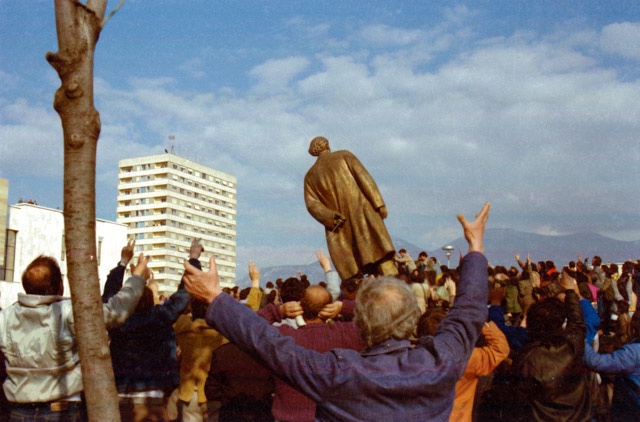
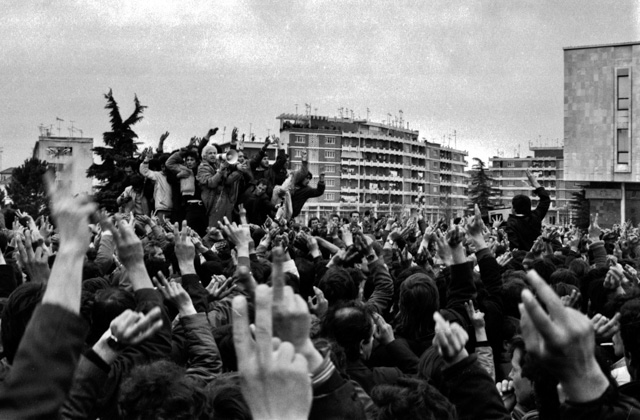
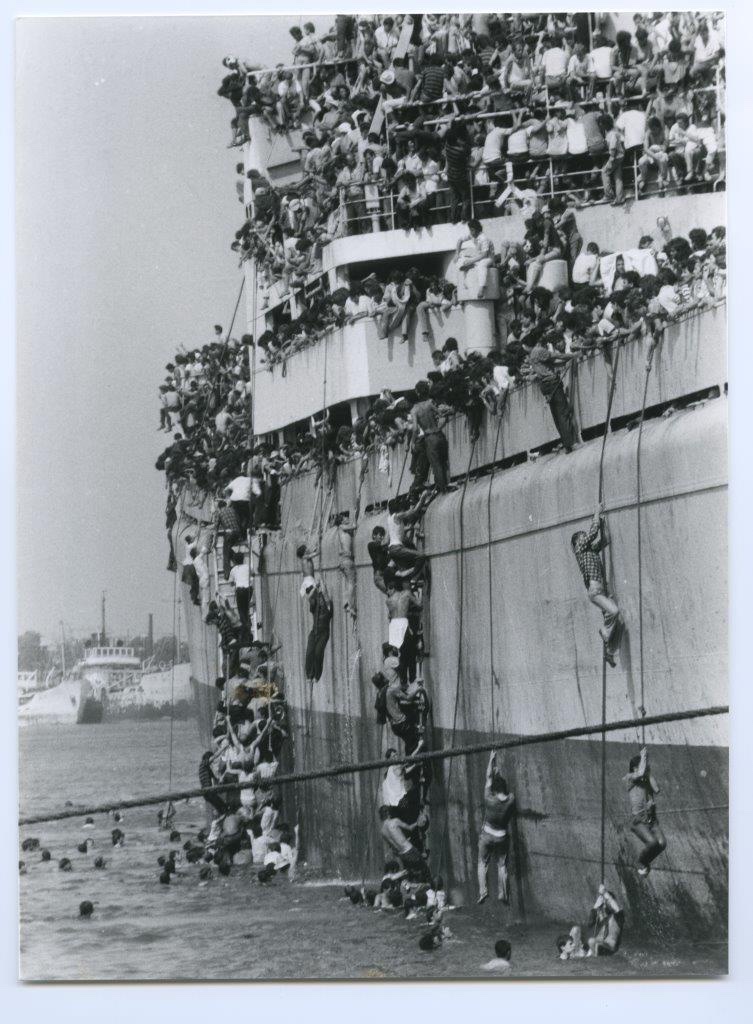
When the petition against the school emerged last week, Ypi’s descriptions of contrasting visions of ‘freedom’ came to mind. It is interesting that contrasting visions can emerge both from between countries, as well as from within a school community. More interesting still, is the contrasting visions of freedom are drawn along similar lines, between my school and a group of parents, as between protesting citizens of socialist Albania, and the socialist state. They differ around ‘the freedom of the individual’ versus ‘the freedom of the collective’, the individuals right to ‘determine who they want to be’ versus the ‘right of an authority to take that decision for them’. As members of a Western liberal democracy, we are literate in enforcing individual rights against the forces of central authority and collectivism. The ideological association in the West of socialism with tyranny, and liberalism with freedom is exposed by Ypi. This sensitivity is manifest in the parent protest.
But the contexts are different. The group of parents are using language which is arguably legitimate to use against a state government, but is less applicable to schools. My view is schools work with children, who are developing the capacity to be fully independent, and who should be guided through that processes. Schools exercise partial authority over individual children, whose families have the freedom to choose schools which fit their values. The school’s job is to provide secure knowledge for students to function successfully when exercising freedom in their daily lives outside the school gates. My experience teaching has shown me that a community of children are not ready to take responsible decisions around their own development, or coexist respectfully with each other. When given freedom to determine when and how they learn, and coexist, children make negative decisions. They require guidance to make good ones. Rules, rewards and sanctions are methods of communicating this guidance clearly.


 Day Off
Leave a reply to charlesthomson8f63c3a369 Cancel reply