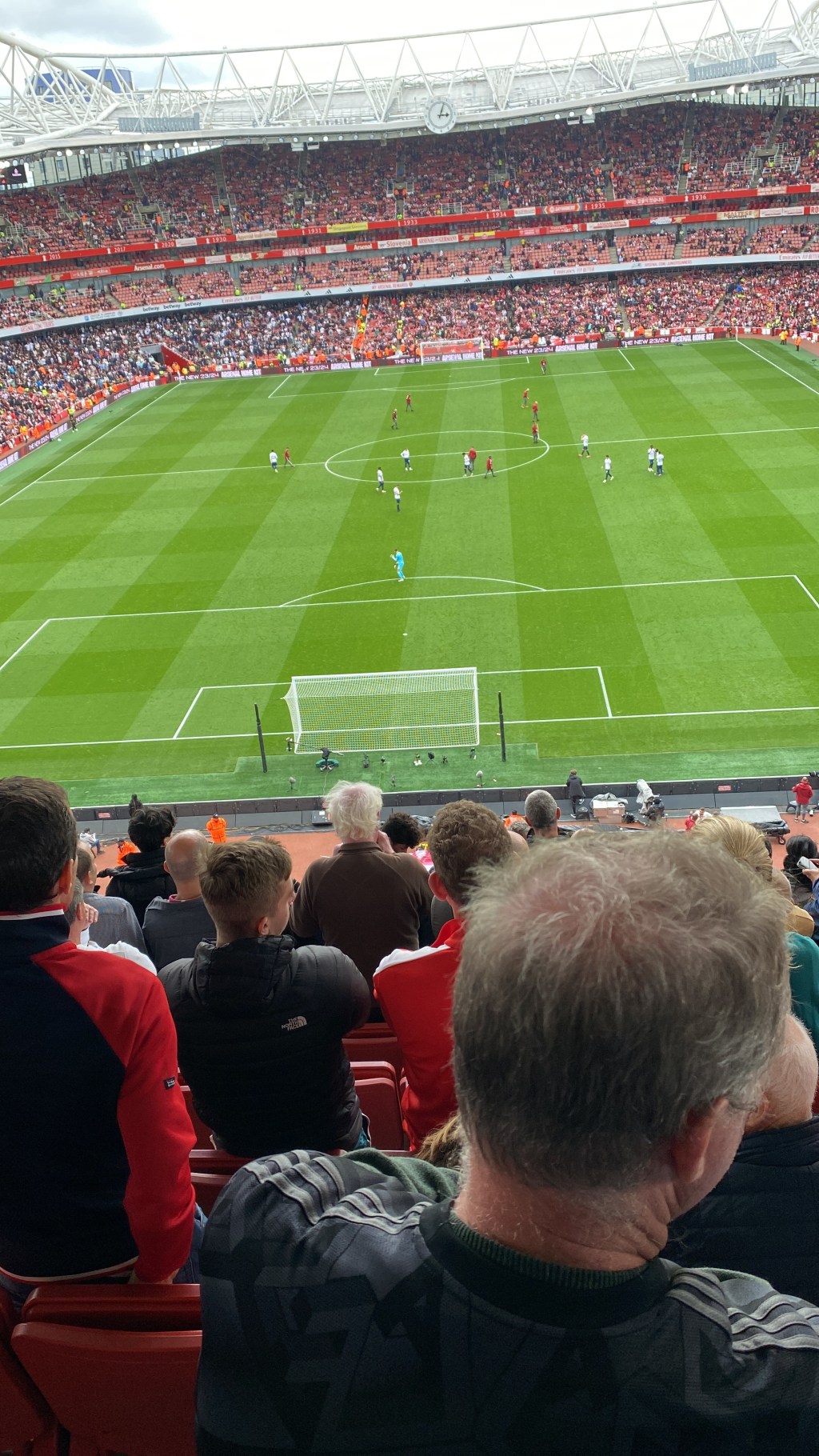
I watched both games in the company of my 8 month old nephew. As we watched the Everton game, he crawled in the space between the television and his family members behind. Before the Spurs game, he arrived in an Arsenal hat. He looked bemused. He had no idea what this ritual was about, and why everyone loved his hat. I have a foggy memory of disliking football. The memory is almost a single image, or flash, of me blocking the screen, failing to understand why the attention of my family had been so completely diverted from me. This post is about space and control in football.
Against Everton, Arsenal had control. Against Tottenham, they did not. At Everton, Arsenal exerted a control over proceedings which contrasted with the United game a week prior, and the same fixture last season. The central cog operating their control was Rice. This was his best game this season. It was a performance through which I felt I understood his worth. The comparison with Arsenal’s 1-0 loss at Goodson last season serves as a useful yardstick with which to measure how Rice has influenced, and could potentially influence his team. Last season Onana, Gueye and Doucoure looked powerful, and their power counted. This season they still looked powerful, but did so against a midfield that looked to have better understanding of space. Rice swept up, intelligently intercepted and used the ball with purpose. He won the midfield battle for control. This was not the case against Tottenham, who our midfield found awkward. Options did not appear, and so delayed, panicked passes followed delayed, panicked passes. The game was bitty and disjointed. Within the internal logic of Tottenham’s shape lurked something enigmatic and dangerous, which made me uneasy. In the parallel realm of my football-dominated weekends, on Saturday my team lost 5-4 (I conceded a last-kick-of-the-game penalty, which they scored). Played the whole 90 + 10 minutes in central midfield. On the car ride home, I reflected about how I can be better at football, to mitigate against the crushing feeling I was experiencing. The game had seemed to pass me by, to happen beyond my sphere of influence. Despite the lack of quality by both sides, there was enough ‘order’ for it to be evident that they had the ‘control’, and this was maddening. The ball fell to them, their actions felt more obvious and effortless, and we ran harder and more fruitlessly. The frustration of being out of control is intense, matched only with the joy of being in it. You feel as though your every attempt at seizing the game back only creates new openings for the opposition. You feel really bad at football. So, I have been thinking a lot recently, how can I experience more control?
Any football player who has been coached as a midfielder will be familiar with the insistence of knowing your next pass, of scanning the pitch to stay ahead of the game. You feel the influence of this everywhere where football is played. Whilst cage football between youngsters is a competition of who can dribble past the most players, quite quickly, at the age of about 10, as the influence of the academies begins to sweep through the generation, value is placed a lot more on playing first time passes, give-and-gos and triangles that you could have only produced had you visualised a future passing pattern before the ball arrived at your feet. All this is to achieve the footballing equivalent of a ‘flow state’, the magical combination of minimal effort and maximum control. Now playing adult football, naturally, I feel this on a team level, or at least at a ‘midfield’ level. Some of the time, the game settles into a kind of flow that you feel in command of. Your mind makes sense of the chaos and it becomes predictable. There is no better feeling than scanning the pitch, hatching an idea for a sequence of passes, then initiating that sequence with a first touch into a space the other team did not expect. If (and it does not happen often enough) you get into a rhythm of these passes there is that ecstatic sensation of basically standing still, or jogging into spaces, while the opposition midfield sprint after every ball in vein, chasing shadows. It’s the Busquets feeling, it’s automaticity, it’s the ecstasy of the flow state.
It was relieving for Arsenal fans to feel like they regained their flow at Everton. I could feel Rice’s satisfaction at nipping in to win the ball, and passing smartly. I could feel Gueye’s frustration at feeling powerless, always expending effort to to intercept and tackle, but rarely succeeding. Zinchenko had one of those games where he was found regularly, and his teammates moved as he wanted them to. Viera and Trossard were the recipients of beautiful, Trent-like clips over the top of the defensive line, as Everton tried to squeeze. These moments are a perfect example of the binary states of control/lack of control . Everton squeeze up their defence and midfield, looking to close the space, hoping to disturb, and Zinchenko clips it over the top into the space they have just left.
There are two basic variables determining who has control of football matches, 1) the ability of players to think ahead execute their actions effectively, and 2) shape. Good players can find themselves chasing shadows if the shape of their team is not right. ‘Shape’, within the context of my own football team, is an illusive term. We often shout it at each other, and often nothing happens. More often, in my team, shape is found and lost almost randomly. You suddenly find everyone is moving with a cohesion, and then it goes and the ball falls into a giant space; cue panic and lots of shouting. This is clearly a sign that we are not a very good team, and we are currently in a very bad patch. We need clarity and cohesion around how we move. It is obviously a matter of coaching. It makes sense that the methods associated with Guardiola now dominate world football. I was talking to a teammate who coaches Hastings United under 15s, who told me that his team play a 3-box-3. I could not believe that 14 year olds understand shape sufficiently to ‘invert’ on the ball, and ‘revert’ off it, but they do, apparently. The ‘box’ as a term to describe four players standing in extremely precise relation to one another, in a square, is indicative of what counts in football; manipulation of space. Tactically, teams divide the pitch into tiny areas of space, and see where overloads can be created. At my level, we understand space basically. There is the wing, the channel, the hole, the CDM space, and then in behind. These are the units of space that we consciously manipulate. Practically, the clearest example of when the shape is not working is during transition; loose balls, second balls and richochets fall to the other team, due to an essentially uneven and disordered distribution of players across the pitch. The spaces on the pitch are occupied in an irregular way. Therefore, when the movement of the ball is random, the chances of it landing with your team fall sharply.
At elite level, the margins between teams are decided by how innovative teams can be in manipulating these spaces. When devising tactical innovations, I imagine Guardiola standing over a birds-eye view of a pitch overlayed with a grid of 1×1 metre squares, overlayed with a heat map of where opposition players tend to defend. Here, he invents new spaces to be identified and exploited. Arsenal’s sequence of short-corners against Everton exemplified such an innovation. In place of the more conventional corner, the random swing into the box, Arteta has placed his 1×1 metre grid on the opposition third and worked out patterns to manipulate the fractions of space. Trossard’s goal vs Everton came from a sequence of passes from players standing in generally un-label-able positions. ‘Edge of the box’ is a label-able position, but a lack of label makes defending difficult. From Tarkowski’s perspective, he could not say ‘Beto… mark edge of the box’, because he would find 5 Arsenal players standing there at 5 metre intervals. And through this example I think we can understand something of the experience of being a Premier League footballer or manager these days. I sense a race for positional labels, concepts and categories. As with any form of knowledge, labels are necessary as tools to pin something down that was previously ill defined (in this case, a 1×1 metre area of the pitch), call it something so that it may be known and understood, so that, ultimately, that ‘thing’ that has been defined can be acted upon in some systematic or meaningful way. I will call that area in the corner of the box where Zinchenko stood for Arsenal’s goal the ‘peach’. Let’s see how Arsenal manipulate in the future. Obviously, teams work it out, apply labels and then shout ‘Beto… Peach’. So continues the footballing ‘space race’.
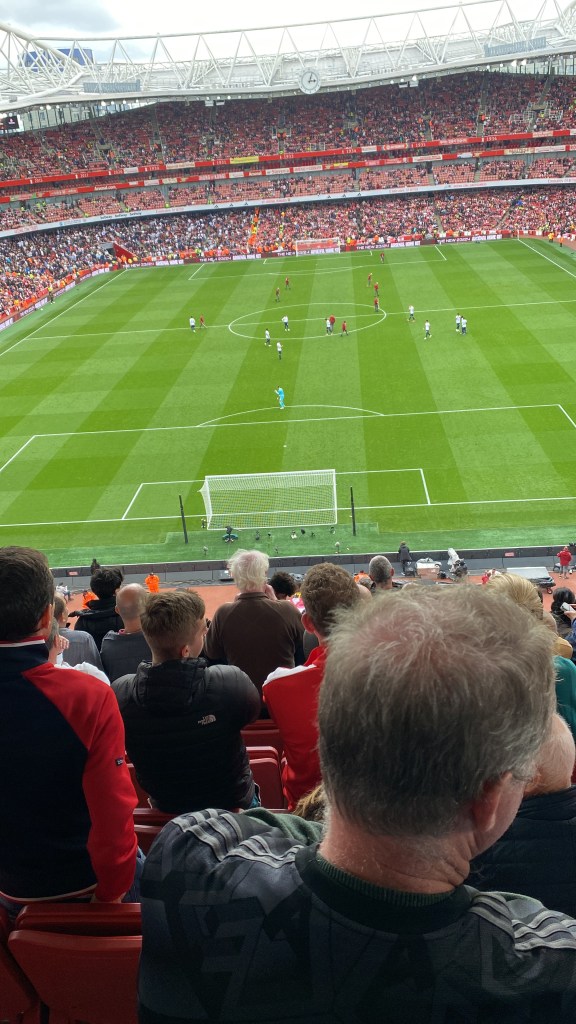
It is a race Ange Postecoglu appears to be excelling at. His shape feels new. Despite the fact that every single one of the hundreds of goal kicks Spurs had during the North London Derby were played short, Arsenal never fully got to grips with them. Arsenal’s press was a frantic scramble to get to out to players (Jesus, Nketiah and Odegaard scurried throughout), while Tottenham played calmly, with authority, as their new space innovation did the work. It is worth saying that Ange has the benefit of being a surprise package, underestimated. There is no doubt teams spent more time over the summer identifying Arteta’s ‘peaches’ than Postecoglu’s, and, to everyone’s surprise, Ange 1.0 is highly effective. There is a new challenge for manages, though. Up and down the country, Postecoglu’s spaces will be being labelled. At some point, he will find himself where Arteta finds himself now, innovating with what used to be a winning formula.
 Day Off
Leave a comment