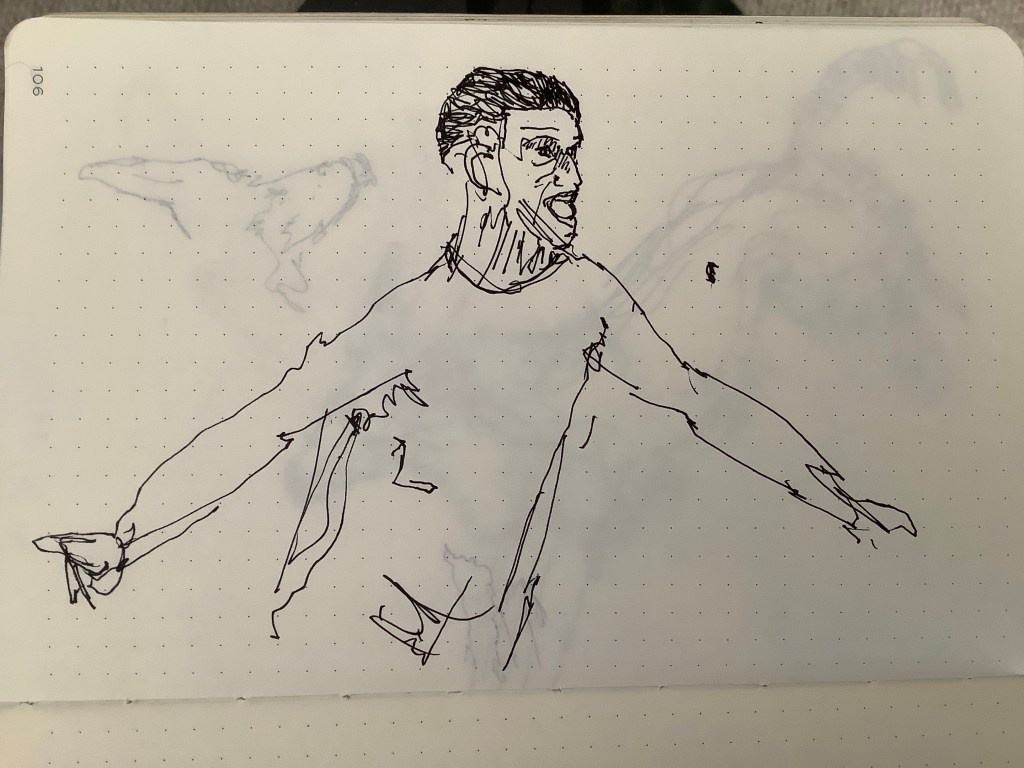
Arsenal 3-1 Man United.
As Declan Rice celebrated Arsenal’s second goal, I ran down to the bottom of the stand and watched the fans in the lower tier of the North Bank celebrate. There were arms, heads and bodies convulsing, both random and patterned. Those scenes make me think of images from the old Wembley; fans celebrating in a kind of dense chaos, clambering limbs all moving at different speeds. I’m sure that is a pre-Hillsborough thing. Unfortunately the pure release of this moment was compromised by my noticing the Manchester United team crowding around the referee, and naturally my mind fretted about a potential VAR review. Still, I turned around to see my brother had taken off his shirt, and as I ran back up the stairs to my seat I saw in the faces around me the many iterations of the same joy.
The game had been played at a bizarre pace. On several occasions during stoppages, two balls ended up on the pitch, yet, maddeningly, no one seemed that bothered. Eventually, the players, officials and a (extremely junior) team of ball boys gestured at each other until someone reluctantly took the initiative. On two occasions, the second ball lay tantalisingly on the line, holding everything up, having been under-hit off, or nervously thrown on. This feeling of being ‘held’ by a ball had a dual-effect; it sapped energy from the pitch and pricked the fans. The laboured atmosphere had pervaded everything, and the fans willed for some intensity. Finally the ball would reluctantly make its way off; a ball boy would run (with their slow, short legs) to collect a ball which had been tapped by a linesman who had just walked over to it. Meanwhile, the players waited.
The Emirates has high expectations. It has taken one season for them to skyrocket back to a title-or-crisis mentality, and it is easy to understand why. Home games last year were characterised by a captivating, searing purpose. Arsenal’s wide players; Zinchenko, White, Martinelli and Saka craved the restart, every stoppage an opportunity to catch the opponent cold with the speed of their movement and mutual understanding. And it feels like it is the latter which has been missing this season. The speed is there, but the clarity of role, movement and inter-relation is not. The almost-symmetrical balance of Arsenal’s team last year was beautiful. Xhaka mastered the role of the illusive third midfielder; not only did he evade opposition lines, hovering in a half space, but his positional discipline gave the whole team a structure. He felt like a weight on a string apparatus, making everything around him taut and precise. He never got in anyone else’s way, or occupied their space, just pulled on the spaces around the pitch, giving all his team mates slightly more. The result, as is the case when teams are functioning well, is that everyone seemed to work less hard to make things happen, the structure did the work. And so, Partey, Zinchenko and Odegaard would effortlessly pass triangles through a press, shoulders and hips relaxed and purring, before releasing another electric attack. By contrast, Arsenal’s new look midfield is struggling to make it work. Rice is dropping deep or wide instead of receiving it through the lines, Havertz is receiving it wide, or one metre from the player on the ball, for easy opportunities to not lose it, and Odegaard is in overdrive, the one player who seemed as frustrated as me at the pace the game was being played.
More frustrating still, was that Manchester United played badly. Really badly. Ten Hag has had several seasons and transfer windows to imprint passing patterns onto his team, but yet again they were playing in moments, in spontaneous movements and combinations. Passes were going behind where someone had run to, or in behind when no run had been made. Their attack looked disorganised; Antony’s best moments were when he recovered to make defensive challenges on Martinelli or Zinchenko. As always, Rashford looked dangerous breaking from the left, and Martial did nothing at all. In midfield, Casemiro looked laboured and lacking in imagination, but then occasionally read and intercepted, and incisively sprung attacks. Eriksen, the pick of the three, passed the ball well and generally marshalled Odegaard diligently, while Fernandes performed in alternate spurts of genuine opposition-slicing quality and arm-throwing, frustrated lethargy.
But it was United’s back 5 which best captured their performance. Particularly their goalkeeper, Andre Onana. It’s difficult to describe his energy. I suppose its a persona of supreme self-assuredness contrasted with the frequent reality of panic. His body language is assertive, he gestures for the ball like an outfielder, even feints to play one pass, then plays another. But then his touch is slightly off, or his pass is weighted strangely, or is misdirected. Not only then is the calmness visibly ripped away, but you’re left feeling like he cares about style over substance, which is hilarious for a goalkeeper. There is also a sense that he has a deluded love of an idea of himself; the mould-breaking modern keeper. He was often trying to split Arsenal’s press with a kind of soft, slightly bobbled through ball for his centre back to run onto and scramble clear. He’d scramble a clearance himself and then sprint back into his goal, before proceeding (persona restored) to receive the resultant goal kick from Lindelof, when the whole charade would repeat again.
It was indicative of a misfiring Arsenal that they were not punished for these chaotic attempts at passing from the back. As is often said about Manchester United, it is unclear what the ‘team’ element of them is. It is remarkable the extent to which each individual plays almost as the purest, synthesised form of themselves, compromising nothing to a ‘team’ identity or ethic. AWB slide tackles and plays short, Martinez also slide tackles, Eriksen drifts, Fernandes waits for his moment, Antony spins round and round. Ten Haag was pleased with how they played, and I can accept that part of Arsenal’s lack of fluidity can be attributed to an effective defensive shape, but, to the untrained eye, United on the ball again look like a team who have not been trained.
 Day Off
Leave a comment